As someone who has been dissecting exchange fee schedules since 2017, let me state the ground truth up front: on no exchange is your real cost the single rate printed on the homepage. BtcTurk is no exception. When the trading commission, withdrawal fee, network fee and — the sneakiest of them all — the spread come together, the total can be double what you expected. In this guide we open up every line item and show you, with concrete numbers, where you can save. If you first want a general picture of the exchange, start with our what is BtcTurk page.
The 30-second answer: how much does BtcTurk charge?
If you are in a hurry, here is the summary. According to the official btcturk.com fee and commission schedule (July 2026), entry-tier commission on TRY trading pairs is approximately 0.12% maker and 0.20% taker. Crypto-to-crypto pairs are cheaper, roughly in the 0.01–0.09% band. Depositing TRY via EFT/FAST bank transfer is generally free; TRY withdrawals carry a small fixed fee, and crypto withdrawals carry a fixed network fee that varies by blockchain. As your 30-day trading volume grows, your commission rate steps down through discount tiers.
This is an independent review site, not the official BtcTurk website. All rates on this page are compiled from the official btcturk.com fee and commission schedule (July 2026) and are approximate. Exchanges can change their fees with notice. Always verify the current rates on the official fee page before you trade.
Maker vs taker, explained at a market stall
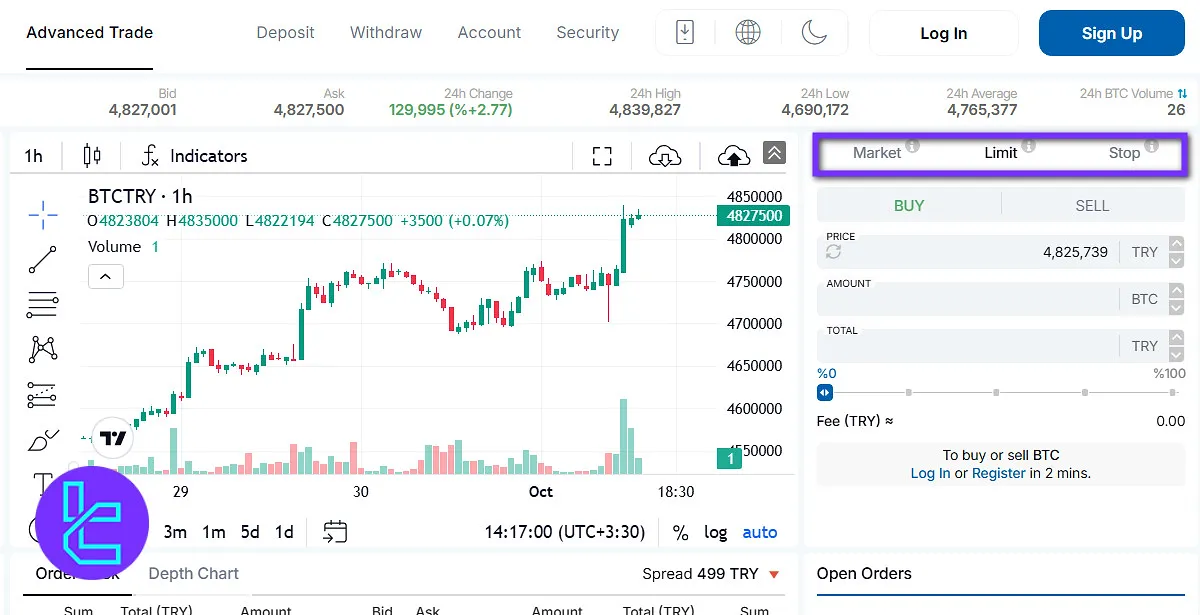
To read any fee table you first need to digest these two words, because the difference between them lands directly in your pocket. In the simplest terms: a maker adds liquidity to the order book, a taker removes it.
Picture a street bazaar. The vendor who sets up a stall and waits — “tomatoes, forty lira a kilo, come and get them” — is adding supply to the market. He is the maker. He might wait an hour; he might not sell at all. The impatient shopper who walks in and says “whoever is cheapest right now, I will buy from them immediately” consumes the existing supply on the spot. She is the taker. Exchange mechanics are identical: place a limit order that sits in the order book and you are a maker; fire off a market order that executes instantly against existing offers and you are a taker.
Exchanges love resting orders, because a deep order book means better prices for everyone. That is why BtcTurk, like almost every exchange, rewards makers with a lower rate: per the official schedule (July 2026), the entry tier on TRY pairs charges makers roughly 0.12% while takers pay roughly 0.20%. In other words, doing the same trade patiently with a limit order is about forty percent cheaper than doing it hastily with a market order. That single fact already repays the time you are spending on this page.
A concrete example: buy 10,000 TRY worth of BTC with a market order and you pay roughly 20 TRY at the 0.20% taker rate. Place the same purchase as a limit order that rests in the book before filling, and you pay roughly 12 TRY at the 0.12% maker rate. The gap looks small — but for someone making twenty trades a month, it compounds into a four-figure sum in TRY by the end of the year.
So when does each order type make sense?
Let us be honest: the limit order is not a sacred rule for every situation. In news-driven moments when the price is running away in seconds, a resting limit order can leave you standing on the platform watching the train depart. In those moments the taker fee is cheaper than the missed opportunity, and a market order is a legitimate choice. But for routine buying, regular accumulation and any pre-planned trade, nothing forces you to hurry — and those trades make up ninety percent of most users' volume. The auditor's rule: make haste the exception and patience the default. And if the screen does not show you which rate will apply before you confirm, keep the official fee table open in a second tab.
BtcTurk spot fee tiers: rates fall as volume rises
In line with common industry practice, BtcTurk uses a tiered commission model based on 30-day trading volume. As your total volume over the trailing 30 days crosses certain thresholds, both your maker and taker rates step down. The table below is an approximate summary of the structure in the official btcturk.com fee and commission schedule (July 2026); consult the official page for exact thresholds and rates.
| 30-day volume (TRY, approx.) | Maker | Taker |
|---|---|---|
| Entry tier (low volume) | ~0.12% | ~0.20% |
| Mid tiers (millions of TRY) | ~0.08–0.10% | ~0.16–0.18% |
| High tiers (tens of millions of TRY) | ~0.04–0.06% | ~0.10–0.14% |
| Very high / institutional tiers | ~0.00–0.05% | ~0.05–0.09% |
| Crypto-to-crypto pairs (general) | ~0.01–0.09% band, varies by pair | |
Two practical conclusions fall out of this table. First: at the high-volume tiers the maker fee can drop to roughly the 0.00–0.05% level, meaning that for someone pushing professional volume, trading cost nearly evaporates. Second: crypto-to-crypto pairs (BTC/USDT, for instance) are distinctly cheaper than TRY pairs. If you trade frequently, converting your TRY to USDT once and routing most of your activity through USDT pairs can meaningfully lighten your total commission load.
Deposit and withdrawal fees: TRY and crypto
The trading commission is the visible tip of the iceberg; entry and exit fees are the mass under the water. According to the official btcturk.com fee and commission schedule (July 2026), the overall picture looks like this:
| Operation | Fee (approx.) | Note |
|---|---|---|
| TRY deposit (EFT/FAST) | Generally free | Your bank may charge on its own side |
| TRY withdrawal | Small fixed fee | Check the current amount in the official table |
| Crypto deposits (BTC, ETH, USDT etc.) | Free | Choosing the correct network is your responsibility |
| BTC withdrawal | Fixed network fee (on-chain) | Updated with Bitcoin network congestion |
| ETH withdrawal | Fixed network fee (gas-based) | Sensitive to Ethereum gas prices |
| USDT withdrawal (TRC-20) | Low fixed fee | Usually the most economical USDT exit route |
| USDT withdrawal (ERC-20) | Higher fixed fee | Runs over Ethereum; gas cost is passed through |
Three things deserve attention here. First, free TRY deposits via EFT/FAST are one of BtcTurk's strongest cards; thanks to its Turkish banking integration, money typically lands in your account within minutes. For the details of opening an account and signing in, see our BtcTurk login guide. Second, the TRY withdrawal fee is fixed — which means it stings proportionally more on small amounts. The fixed fee you pay withdrawing 500 TRY is the same as withdrawing 50,000 TRY, so batching withdrawals is always the mathematically smarter move. Third, crypto withdrawal charges work on network fee logic rather than commission logic, and the exchange updates them as chain conditions change.
Do not forget the line items outside the table, the ones the exchange does not control. Your bank may apply its own tariff to EFT transfers; FAST payments are free up to a certain amount at most banks, but that ceiling varies from bank to bank. On weekends and at night, FAST keeps running, so money usually still arrives within minutes; classic EFT is bound to business hours. Auditor's tip: test your first deposit with a small amount, watch with your own eyes what the bank skims and how long the transfer takes, and only then send the real sum.
The hidden cost: the spread in easy buy/sell mode
Now we arrive at the most important section of this page. After years of auditing fee tables, I can tell you: the place where users lose the most money is not the commission table — it is the spread, the gap between the price you are quoted and the actual market price.
BtcTurk offers two trading interfaces. The “easy buy/sell” screen is designed for beginners: type an amount, tap once, done. It is convenient — and the price of that convenience is a spread baked into the quote. In the Pro interface you see the order book, place your own limit or market order, and pay only the commission printed in the schedule.
A purely illustrative scenario (not official data): on a 10,000 TRY BTC purchase, the Pro screen charges you ~0.20% as a taker, about 20 TRY; go maker with a limit order and it is ~0.12%, about 12 TRY. The spread embedded in the easy buy/sell quote, depending on market conditions, might run around 0.5–1% — an extra ~50–100 TRY on the same trade. In other words, “easy mode” can cost up to eight times more than a limit order.
Before we brand this a scandal, let us be fair: the embedded-spread model is the industry standard, and the simple-purchase screen of virtually every exchange on earth works the same way. The problem is not that the model exists; it is that most users have no idea it exists. The fix is simple: except for small, one-off purchases, do every trade on the Pro screen, ideally with a limit order. A five-minute learning curve buys you percentage points on every trade. Our BtcTurk price page is a good place to start learning to read the price screens.
Network fees: why picking the right chain is critical
What you pay on a crypto withdrawal is not an arbitrary exchange commission; it is the pass-through of the network fee paid to miners and validators for writing your transaction to the blockchain. That is why the gap between networks is a canyon. Withdrawing the same 1,000 USDT:
- TRC-20 (Tron network): a low fixed fee per the official schedule — often below a few USDT. Usually the sensible route for small and medium amounts.
- ERC-20 (Ethereum network): distinctly more expensive, driven by gas prices. When Ethereum is congested, the gap multiplies.
- BTC (Bitcoin network): a fixed on-chain withdrawal fee updated with congestion; it climbs when demand for block space spikes.
And network choice is not merely a cost question — the wrong choice can vaporise your money entirely:
Warning: Network selection on a crypto transfer is irreversible. Sending over TRC-20 to an ERC-20 address (or vice versa) can end in permanent loss of funds if the receiving platform does not support that network. Every single time, check that the network label on the withdrawal screen matches the deposit network on the receiving platform exactly — and send a small test amount before any large transfer. No commission saving on earth compensates for a balance sent down the wrong chain.
Seven concrete ways to pay lower fees
Theory is nice, but an auditor's job is to hand over the savings as a checklist. Here are seven proven ways to cut your total cost on BtcTurk:
- Use limit orders. The maker rate (~0.12%) is distinctly below the taker rate (~0.20%). For every non-urgent trade, place a limit order instead of a market order; a few minutes of waiting in the order book translates into roughly forty percent commission savings per trade.
- Batch your withdrawals. TRY and crypto withdrawal fees are fixed. One consolidated withdrawal a month instead of five small ones a week has the same effect as dividing the fixed fee by five.
- Pick the cheap network. If you are withdrawing USDT and the counterparty supports it, TRC-20 is often several times cheaper than ERC-20. Compare the network fees side by side in the official table before withdrawing.
- Watch your volume tier. If your 30-day volume is approaching the next threshold, pulling planned trades forward can move you permanently into a lower commission tier.
- Avoid easy buy/sell for size. The embedded spread scales with the amount. Make the Pro screen your habit for every trade above roughly 1,000 TRY.
- Time your ETH withdrawals. Ethereum gas prices swing through the day, and the network fee table is updated accordingly. If it is not urgent, wait for a quiet hour on the chain.
- Check the official table before every trade. Rates change. No third-party source — this page included — replaces the official btcturk.com fee page. A thirty-second check is your insurance against surprises.
Total cost by scenario: small, medium and large trades
Let us turn the rates into pocket money. The table below shows the approximate cost of three methods across three trade sizes. The figures are illustrative calculations using the entry-tier rates from the official schedule (July 2026) and a sample spread assumption:
| Trade size | Limit order (maker ~0.12%) | Market order (taker ~0.20%) | Easy buy/sell (sample spread ~0.75%) |
|---|---|---|---|
| 1,000 TRY | ~1.2 TRY | ~2 TRY | ~7.5 TRY |
| 10,000 TRY | ~12 TRY | ~20 TRY | ~75 TRY |
| 100,000 TRY | ~120 TRY | ~200 TRY | ~750 TRY |
The table tells its own story: on a 100,000 TRY purchase, the gap between a limit order and easy mode is ~630 TRY under the sample assumptions — more than many users' entire monthly withdrawal fees. Your choice of method is a bigger cost item than the rates themselves.
Now put it in an annual frame. Picture a representative user making ten trades a month at 10,000 TRY per trade. Running everything through market orders costs roughly 2,400 TRY a year in commission; the same trades as limit orders come to roughly 1,440 TRY. Push it all through easy buy/sell and, under the sample spread assumption, the annual cost approaches 9,000 TRY. The difference between those three scenarios requires no market timing and no extra risk — only knowing which button you are pressing. The return on fee literacy is more certain than the return on most trading strategies.
How do BtcTurk's fees stack up globally?
Let us make an honest comparison. Founded in 2013 and the longest-standing exchange in Türkiye, BtcTurk is competitively positioned on the TRY on/off-ramp against both local rivals and the TRY integrations of global exchanges: free, fast TRY deposits via EFT/FAST are a tangible advantage for users in Türkiye. Operating as a licensed platform after Law No. 7518 (2024) and the Capital Markets Board's (SPK) Communiqués III-35/B.1–B.2 (March 2025) also provides a framework that reduces the risk of arbitrary fee changes — we examined that regulatory arc in detail on our is BtcTurk safe page.
On the global stage, however, different structures exist: some international platforms offer different maker-taker bands, different fee models on stablecoin pairs, or different on/off-ramp terms in their own local currencies. If you want to keep part of your portfolio on an international venue, you can compare a global alternative platform operating since 2013 against BtcTurk's own schedule. The auditor's rule never changes: whatever the platform, read its current fee page line by line before deciding.
When you compare, make sure you are comparing apples with apples. A platform's low-looking taker rate can end up costlier overall once it is paired with an expensive withdrawal fee or a wide spread. The right method is to price your own typical transaction — amount, pair, network and withdrawal frequency included — end to end on both platforms. Use the scenario table above as a template: fill in the same three rows with the candidate platform's rates and compare the totals. That ten-minute exercise is a far more reliable basis for a decision than the large-print rates on marketing pages.
Pros and cons of BtcTurk's fee model
Pros
- TRY deposits via EFT/FAST are generally free and arrive within minutes
- Maker rate (~0.12%) is competitive by regional standards
- 30-day volume tiers can cut rates substantially
- Crypto-to-crypto pairs sit in a low ~0.01–0.09% band
- Crypto deposits are free
- A transparent, published fee schedule under SPK regulation
Cons
- The embedded spread in easy buy/sell quietly taxes new users
- The entry-tier taker rate (~0.20%) sits above the cheapest global league
- The fixed TRY withdrawal fee weighs proportionally on small amounts
- ERC-20 withdrawals get expensive when gas is high
- Tier discounts rarely reach low-volume retail users in practice
AUDITOR'S VERDICT
BtcTurk's fee schedule is an honest, competitive structure for the Turkish market: free TRY deposits, a reasonable maker rate, and commissions that step down with volume. But your real cost depends far more on your behaviour than on the rates. A user who trades with limit orders on the Pro screen instead of easy buy/sell, batches withdrawals and picks cheap networks pays a fraction of what a careless user pays on the very same exchange. The rule is simple: verify the rates on the official schedule, never forget the spread, and never pay a commission for impatience. For the rest of our coverage, see the guide map on our home page.
Frequently Asked Questions
How much are BtcTurk trading fees?
According to the official btcturk.com fee and commission schedule (July 2026), the entry tier on TRY pairs is approximately 0.12% maker / 0.20% taker; crypto-to-crypto pairs fall to roughly the 0.01–0.09% band. Rates step down as your 30-day trading volume grows. Because rates can change, always check the official fee page before you trade.
What is the difference between maker and taker fees?
A maker places a limit order and adds liquidity to the order book; a taker consumes existing liquidity instantly with a market order. Exchanges reward the user who fills the book: on BtcTurk the entry tier charges makers about 0.12% while takers pay about 0.20%. Using limit orders means doing the same trade roughly forty percent cheaper.
Does BtcTurk charge for deposits?
Per the official fee schedule (July 2026), TRY deposits via EFT/FAST are generally free and usually credited within minutes; crypto deposits are also free. The only possible charge is a transfer fee your own bank might apply on its side. For the full deposit walkthrough, see our login and account guide.
How much is the BtcTurk withdrawal fee?
TRY withdrawals carry the small fixed fee stated in the official table; crypto withdrawals carry a fixed network fee that depends on the chain you choose. Withdrawing USDT over TRC-20, for example, is often several times cheaper than over ERC-20. Since fees are updated with network conditions, verify the current amount on the official btcturk.com fee page before withdrawing.
How can I lower my BtcTurk fees?
The three most effective levers: trade at the maker rate by using limit orders instead of market orders, batch your withdrawals so the fixed fee is spread across fewer transactions, and choose cheap networks such as TRC-20 for USDT withdrawals. Also track your 30-day volume — reaching a higher tier lowers your rates permanently. And keep sizeable trades away from the easy buy/sell screen.
What is the spread, and why can it matter more than the commission?
The spread is the gap between the buy/sell price you are quoted and the actual market price. On simple purchase screens like easy buy/sell, that gap is baked into the quote and in sample scenarios can reach roughly 0.5–1% — several multiples of the visible ~0.12–0.20% commission. That is why any honest cost calculation must always count the spread alongside the commission.